
AML/CTF software for real estate agencies
Check the vendor and the buyer with a link, screen them against DFAT and PEP data, and keep a record of every sale.
General information, not legal advice.
Which of your services are covered
AUSTRAC's real estate designated services guidance covers brokering the sale, purchase or transfer of real estate, and selling real estate without an independent agent. Here is how common agency work lines up. If a row is unclear, use the free scope check or ask AUSTRAC.
| Service | Covered? | Why |
|---|---|---|
| Acting as a seller's agent to sell a house, unit or land | Covered | Brokering a sale. You start providing the service to the seller when the agreement to broker the sale is signed, and to the buyer once the transaction is expected to proceed. |
| Acting as a buyer's agent to find and buy a property | Covered | You start providing the service to the buyer when the agreement to find a property is signed. |
| Selling at auction | Covered | Covered. If completing initial due diligence on the buyer would disrupt the ordinary course of business, you can delay it (delayed due diligence). |
| A developer selling house and land packages or off-the-plan apartments with in-house sales staff | Covered | Selling real estate without an independent agent is its own designated service. The buyer is the customer. |
| Selling or transferring a lease of more than 30 years, a crown or pastoral lease or a land use entitlement | Covered | These count as real estate. |
| Residential property management and leasing of 30 years or less | Not covered | A lease of 30 years or less is not real estate. The AML/CTF Rules also exclude managing rental income and expenses through a trust account from the money-handling service. |
| A private sale of a home by its owner | Not covered | Private sales of residential property and incidental sales by a business are not part of a business selling real estate. |
Your obligations, and how ScreenlyyID handles each
ScreenlyyID handles the checking, tracking and record keeping, and builds your written program from AUSTRAC's real estate program starter kit. Responsibility for compliance stays with your agency, and some steps are done in AUSTRAC Online, not in ScreenlyyID.
| Obligation | In ScreenlyyID? | How it is handled |
|---|---|---|
| Enrol with AUSTRAC | Guided by ScreenlyyID | Apply to enrol no later than 28 days after you start providing a designated service (AUSTRAC). Enrolment is done in AUSTRAC Online. |
| Appoint and notify a compliance officer | Guided by ScreenlyyID | Done in AUSTRAC Online (guidance). |
| AML/CTF program: risk assessment, policies and processes | In ScreenlyyID | The written program is generated from the documents in AUSTRAC's real estate program starter kit, approved by named people, frozen as a version and exported as a PDF. |
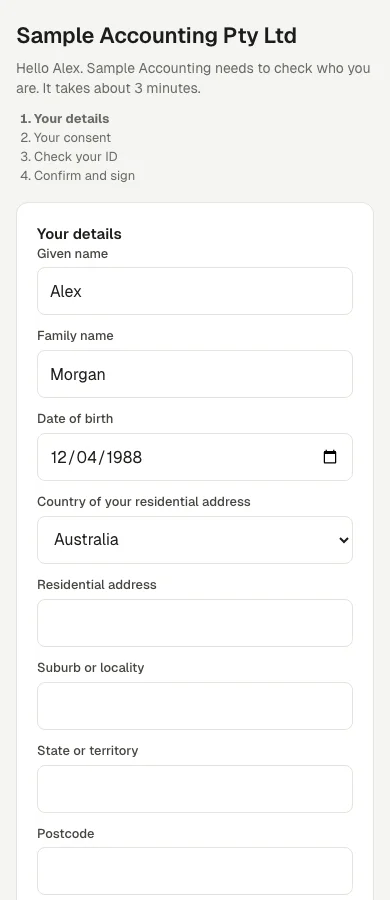
| Customer due diligence on the buyer and the seller | In ScreenlyyID | Send each party a secure link when you are instructed. They give consent, check their ID on their phone and sign a declaration, and you review the result. Companies and trusts get a client file with their owners. |
| Beneficial owners of companies and trusts | In ScreenlyyID | ScreenlyyID uses AI to extract the information from any document you upload, such as a trust deed or an ASIC document, and you review it. It builds the ownership tree with a 25% ownership rule (trust guidance). Document reading is 3 a month on Free and fair use on Solo and Practice. |
| Sanctions and PEP screening, including DFAT | In ScreenlyyID | Each person is screened against the DFAT Consolidated List and PEP data (DFAT sanctions, PEPs). |
| Ongoing due diligence | In ScreenlyyID | Recurring re-checks raise alerts, and reviews are scheduled by risk. For an agency, most of the work is at the start of a sale, with repeat vendors and investors reviewed later. |
| Suspicious matter reports | Partly in ScreenlyyID | An alert can become a draft report with the deadline counted: 3 business days, or 24 hours for terrorism financing (AUSTRAC). You lodge it in AUSTRAC Online. |
| Record keeping | In ScreenlyyID | Checks, decisions and files are kept for seven years (AUSTRAC), and a client file exports as an evidence pack. |
| Staff training | Partly in ScreenlyyID | A training list with completion records for your staff (AUSTRAC). The training content itself is outside ScreenlyyID. |
| Independent evaluation | Guided by ScreenlyyID | The evaluator must be independent, so it is outside ScreenlyyID. Find your due date with the key dates calculator. |
How a client check works
The vendor does their check when they sign the agency agreement, not in the week of the campaign.
- 1
Create the file for the sale
Add the vendor, and the buyer when the offer is accepted. AUSTRAC treats both as your customers.
- 2
Send each party a secure link
Send it by the channel you already use. Nobody installs anything or creates an account.
- 3
They complete it on their phone
Details, consent, an ID check and a signed declaration, usually in a few minutes.
- 4
Review and record the decision
See the screening result and risk rating, then sign off. The file keeps the evidence for the sale.
Selling at auction? You can delay due diligence on the buyer where it would disrupt the ordinary course of business. Record why, and finish it as soon as you can.
Pricing and integrations
You can start free: one user, unlimited clients and one free ID check. The Solo plan is $59 a month (AUD): up to 3 users, unlimited clients, ongoing PEP and sanctions monitoring for up to 300 people and 8 ID checks a month, with extra checks at $6 each. Pay monthly or yearly, no setup fee and no 12-month contract. See the Tranche 2 plans, or pricing for the wider platform if you want to build checks into your own system.
Today you can send checks by no-code link or QR code over SMS, WhatsApp or email, run them from the dashboard, or build them into your own system with the Web SDK and REST API (integrations). ScreenlyyID does not list a practice management or case management integration. Software vendors can ask about the partner program.
Questions agencies ask
How much does Tranche 2 compliance software cost?
You can start free, with unlimited clients and one free ID check. Solo is $59 a month ($590 a year) and Practice is $129 a month ($1,290 a year), in AUD, with extra ID checks at $6 each ($11 on Free). See the Tranche 2 plans for what each includes.
Do real estate agents need to enrol with AUSTRAC?
Yes, if you broker the sale, purchase or transfer of real estate. You must apply to enrol no later than 28 days after you start providing the service (AUSTRAC).
Who is my customer, the buyer or the seller?
Both. When an agent acts for the seller and brokers the sale, AUSTRAC says the customer is both the buyer and the seller, so you have obligations to both (AUSTRAC).
Is property management covered?
Not as a sale. Leases of 30 years or less are not real estate, and the Rules exclude managing rent through a trust account. Check the guidance if you also sell, or hold money for other purposes.
What if I got a section 167 notice?
AUSTRAC began issuing section 167 notices to businesses such as real estate agents that appear to provide designated services but have not enrolled on 28 August 2026 (AUSTRAC). Read our section 167 notice guide and respond by the date on your notice.
We are part of a franchise or network. Do we still need our own program?
Each business that provides a designated service is a reporting entity. AUSTRAC's guidance on reporting groups covers when a group can share obligations. Ask your network and, if needed, a lawyer.
Keep reading
General information, not legal advice.
Sources:
Start free with ScreenlyyID
Unlimited clients and your first ID check included. Not sure which of your services are covered? The 2-minute scope check tells you.
ScreenlyyID helps you meet your obligations; responsibility for compliance stays with your business.